

BYD Dolphin – The ultimate comparison to choose your EV!
The BYD Dolphin lineup has become the most convincing entry point for anyone who wants to move from combustion to an electric car in Brazil. In this comparison, we clearly and opinionatedly explain what really changes between the Dolphin Mini, GS and Plus — price, package, range, performance and ideal driver profile — so you can understand which version delivers the best cost-benefit for your routine. The idea is simple: go from “I’m not sure about BYD” to “now I know exactly which Dolphin to buy.”
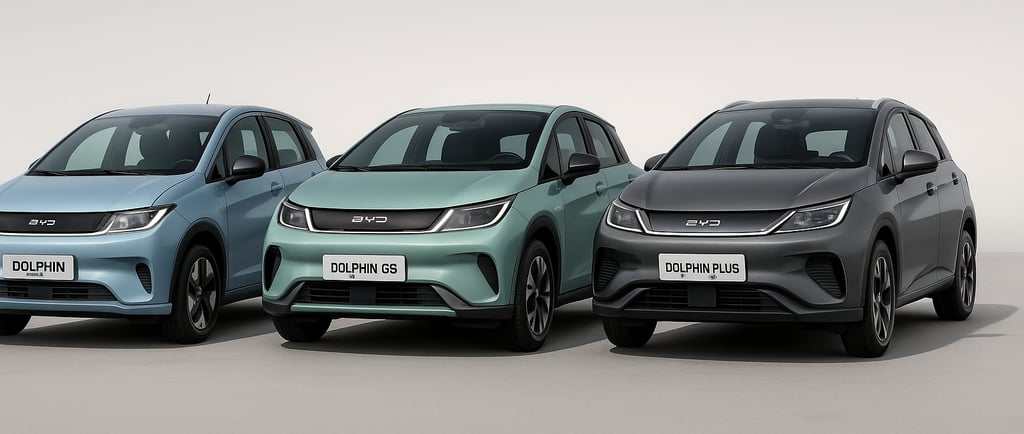
BYD Dolphin Mini vs GS vs Plus: which is the best value and who each one is perfect for?
You don’t have to be an enthusiast to notice that BYD has done something rare in Brazil: it created an electric family with three clearly defined steps in purpose, price, and ownership experience. And that changes the game for anyone thinking about leaving combustion behind.
Because for the first time, the question stopped being “Are electric cars any good?” and became something much more interesting:
Which EV makes the most sense for my daily life without forcing me to pay for a step I don’t actually need yet?
That’s exactly the problem the Dolphin lineup solves.
And yes: Mini, GS, and Plus may sound close on paper, but they represent three different ownership experiences.
First of all: the golden rule of buying an EV the right way
Buying an EV becomes simple once you understand one logic:
The ideal car is the one that matches range, routine, and charging access.
If you can charge easily at home or work, any Dolphin becomes far more attractive.
If you depend 100% on public charging, your choice needs to be even more rational.
BYD designed the Dolphin trio with this in mind.
What each Dolphin is in real life
BYD Dolphin Mini: the EV that democratizes the transition
The Mini has a clear mission: to be the first truly viable EV for people who live the city.
In its regular version, BYD states a 38 kWh LFP Blade battery and 280 km of Inmetro range.
That already places it in a very honest tier for urban use.
But there’s an important market detail that a serious magazine won’t ignore:
recent reports point to a 2026 Mini GL version aimed at direct sales, with a smaller battery and reduced range of 250 km.
So when you compare prices, make sure you’re looking at the exact version being offered.
Now the editorial point:
Is the Mini worth what it costs?
Yes—if your use is mostly urban and you want to enter the EV world without blowing your budget. It delivers technology, safety, and practicality in a compact, modern package. In the Brazilian market context, it’s one of the most coherent entry-level EVs for anyone who wants to start the right way.
BYD Dolphin GS: the best balance in the family
The GS is the Dolphin that tends to please the largest number of people because, essentially, it’s the ideal single-car choice for those who want an EV without radically changing their lifestyle.
With a 44.9 kWh LFP battery, a 95 hp motor, and 291 km of Inmetro range, the GS offers a truly meaningful jump in “car substance” compared with the Mini.
And the 2026 lineup was repositioned to R$ 149,990, with equipment updates that strengthened its value proposition.
Is the GS worth this price?
Here’s my magazine-level verdict: yes, and probably more than any other Dolphin for most people.
It’s not the cheapest, not the strongest, but it combines the right things best:
balanced official range,
a more mature hatch size and comfort level,
a new price tier that makes the step-up easier to justify.
If you’re looking for the best overall cost-benefit in the Dolphin family, the GS is the most solid candidate.
BYD Dolphin Plus: the EV that makes you forget combustion
The Plus is a different conversation.
It doesn’t exist to be “a GS with a nicer name.”
It exists to be the complete electric hatch—the version that delivers a more aspirational, stronger, more definitive experience.
BYD highlights 204 hp, an LFP Blade battery of around 60.5 kWh, and 330 km of Inmetro range.
And recent price references place it around R$ 184,800.
Is the Plus worth this price?
My editorial take is straightforward:
yes—if you want performance and long-term satisfaction.
The Plus is the Dolphin you buy thinking:
“I want to enter the EV world at the right level, without that feeling of ‘I’ll probably want to upgrade soon.’”
And there’s a practical detail that reinforces this argument:
when the Plus enters network campaigns and incentives, it can get close to the GS’s psychological price territory—and then the Plus’s value proposition grows dramatically.
What one has that the others don’t
Instead of a dry list, here’s the real experience jump between the steps.
1) From Mini to GS: the leap from “smart entry” to “true one-car solution”
The extra money you pay for the GS doesn’t just buy a few more kilometers of range.
It buys a more adult car for real life.
You gain:
a stronger sense of stability and daily comfort,
a more balanced battery-and-motor combo for mixed city and light highway use,
a more complete hatch package for small families and varied routines.
This is the step where the EV stops being an “urban experiment” and becomes a primary solution.
2) From GS to Plus: the leap from “rational balance” to “desirable EV”
The Plus changes two things in a big way:
First, the driving dynamics.
With 204 hp, it delivers acceleration and responsiveness that transform urban use and make most everyday combustion cars feel less sharp.
Second, battery breathing room and mental peace.
Those official 330 km create a bigger psychological cushion for those who don’t want to plan the week around charging.
It’s the Dolphin you buy not only with logic—but with genuine enthusiasm.
*Prices vary by region, model year, and promotions.
Which profile each version fits best
Mini is the perfect buy for those who:
live mostly urban routines, want low running costs, and want the lowest entry ticket into EVs without giving up a modern platform.
GS is ideal for those who:
want an EV as their main car, need the best balance between price, range, and daily usability, and prefer a complete, rational decision.
Plus is right for those who:
value performance, want more official range, and want the feeling of being at the “definitive level” of the electric hatch experience.
Conclusion
If I had to reduce everything to one editorial sentence per version:
Dolphin Mini is the EV that makes sense for the city and for your wallet.
Dolphin GS is the smartest Dolphin for most buyers today.
Dolphin Plus is the version that delivers the most driving pleasure, energy breathing room, and a mature sense of choice.
What BYD did here was simple and brilliant:
three doors to the same future.
And if you’re just starting to consider an EV now, the Dolphin family is one of the most logical and safe ways to enter this transition without regret.


Contact
Questions or Suggestions? Talk to Us!
+55 48 998037616
EvsReviews © 2025. Todos os direitos reservados.